

Peter McCullough was stripped of his board certification in cardiology and internal medicine in a disciplinary sanction. He was notified of the decison in 2022, exercised a vigorous appeal and lost in 2025.
https://www.documentcloud.org/documents/23242430-abim-decision-on-mccullough/
https://www.medpagetoday.com/special-reports/features/113624
The American Board of Internal Medicine was very critical of McCullough for providing false information to the public.
The Texas Medical Board requires physicians to disclose certain disciplinary actions and sanctions, particularly during licensure application and renewal.
The reporting obligations generally include adverse actions such as:
disciplinary action by another state medical board,
restrictions/suspensions/revocations of hospital privileges,
certain peer review actions,
DEA registration actions,
criminal convictions or deferred adjudications,
and other professional sanctions related to the practice of medicine.
Texas renewal and application forms include “professional history” questions asking about these kinds of events. Physicians are expected to answer truthfully and completely.
The key nuance is:
👉 the TMB focuses primarily on licensure, credentialing, and professional discipline affecting the ability to practice medicine safely and ethically.
So:
a disciplinary sanction by another medical licensing authority is clearly reportable,
many hospital privilege sanctions are reportable,
peer review actions often are reportable,
but purely private organizational matters are less straightforward.
That’s why the ABIM issue is nuanced:
ABIM is a private specialty certifying body, not a state licensing board.
Loss of board certification alone does not appear explicitly listed as a mandatory reportable event in the same way as license suspension.
However:
if the underlying action involved findings of unprofessional conduct,
misinformation affecting patient safety,
fraud,
or credentialing misrepresentation,
then disclosure obligations could become more complicated depending on:
the wording of renewal questions,
hospital credentialing forms,
and whether the sanction triggered other reportable actions.
The important practical reality:
👉 physicians generally disclose broadly when uncertain, because failure-to-disclose often creates more risk than the underlying event itself.
And for controversial disciplinary situations, physicians almost always consult:
healthcare counsel,
malpractice counsel,
or physician-license defense attorneys before renewal disclosures.
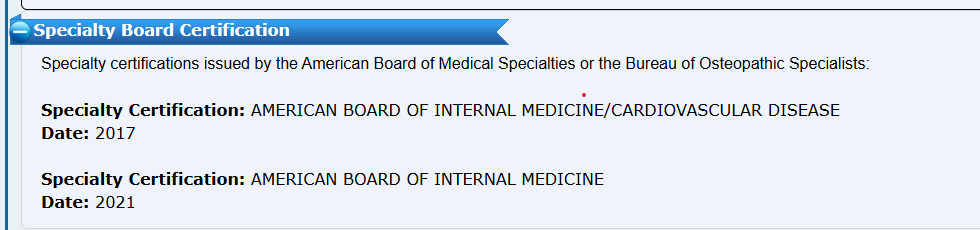
However, the Texas Medical Board still shows Dr. McCullough as being board certified. In Texas, licensed physicins are required to renew their license every two years. So, it appears Dr.McCullough may not have self dislosed the ABIM discipinary sanction as required.
https://profile.tmb.state.tx.us/PublicProfile.aspx?4d0c2203-bd89-44d5-9289-66053abb1c90
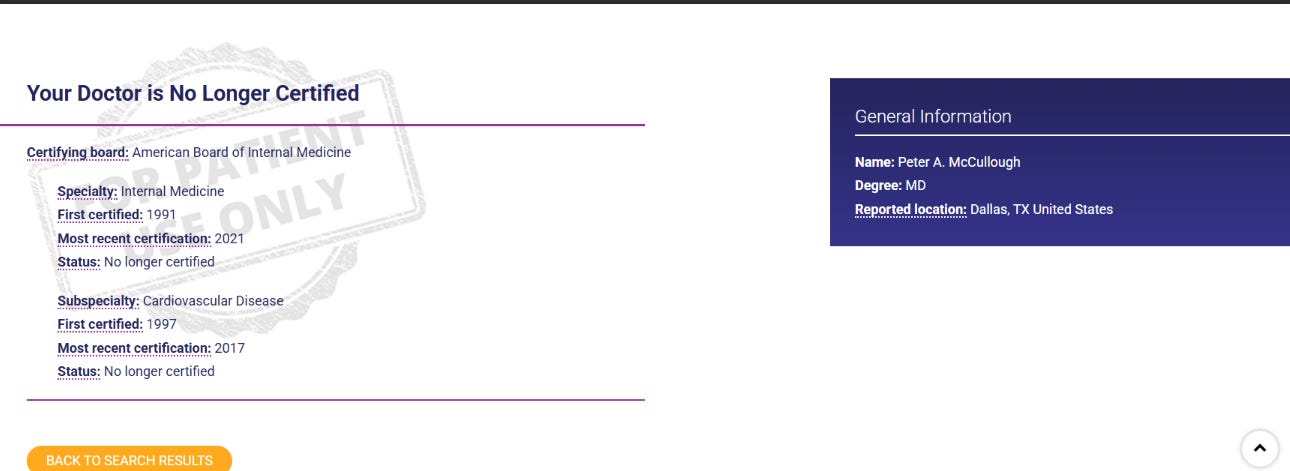
The American Board of Medical Specialties clearly states Dr. McCullough is “no longer certified”.
In addition to disclosing sanctions and revocation of board certification to medical boards, it is also required that such actions be reported to insurance companies.
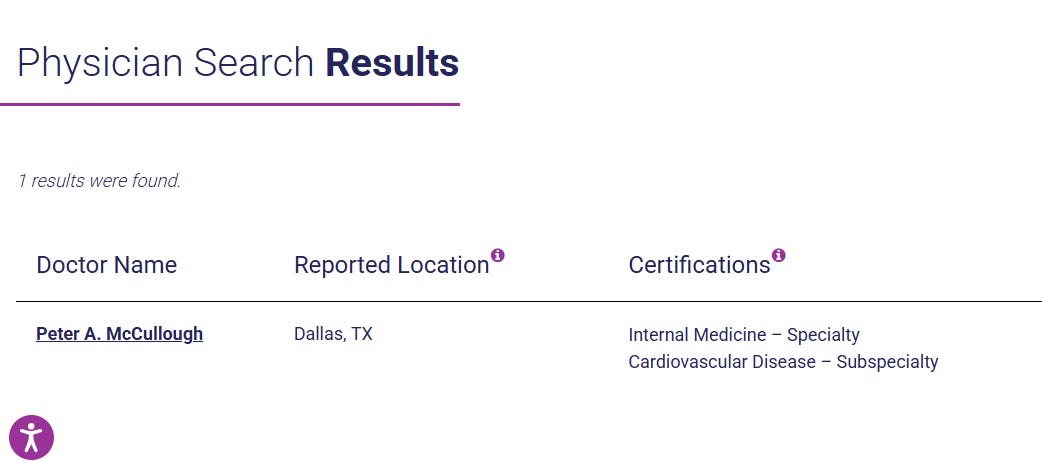
As of May 14, 2026, Dr. McCullough is incorrectly identified as board certified on Texas Blue Cross / Blue Shield website.
But wait, there’s more! Dr. McCullough still represents that he has hospital privileges at Baylor and Scott and White on the Texas Blue Cross Blue Shield website.
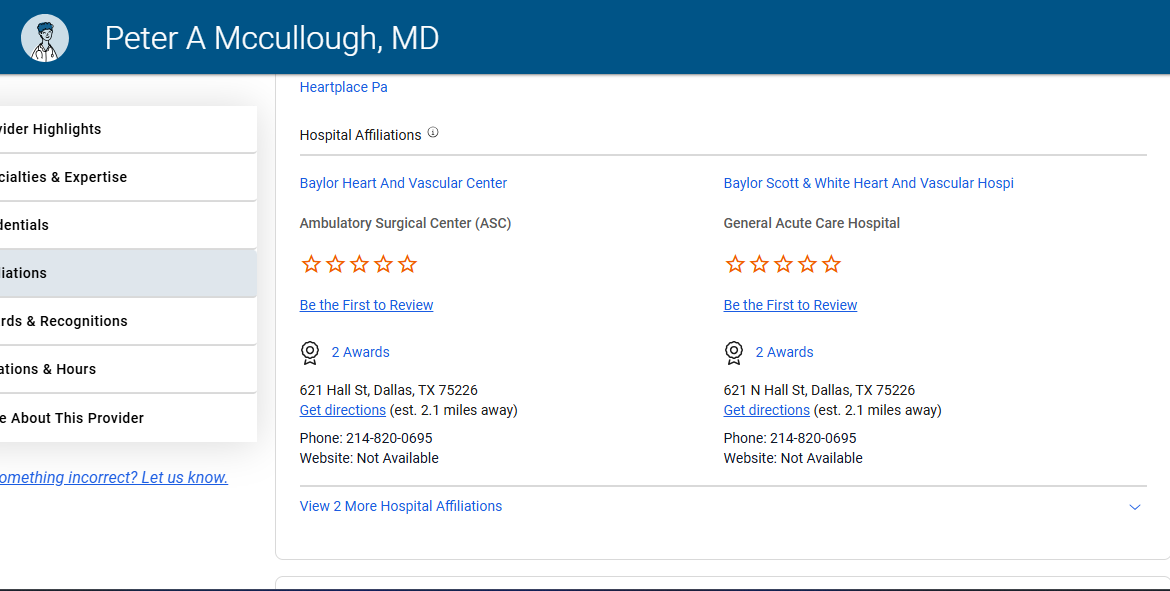
This important because it was the subject of litigation.
https://www.medpagetoday.com/special-reports/exclusives/93936
McCullough was abruptly removed from the medical staff at Baylor, Scott & While Health in approximately 2020. In 2012, Baylor sued McCullough for falsely representing he still had an affiliation with the hospital. That suit eventually settled with McCullough agreeing to stop making such false claims. Apparently, he has yet to correct his credentailing information with Texas Blue Cross and Blue Shield.
Why does this matter?
Because patients deserve to know what qualifications doctors have and don’t have. They also deserve to know if their doctor has been sanctioned. These patient rights are protected by law.
There are consequences for failing to notify a state medical board of disciplniary sanction and revocation of board certification.
Potential consequences can be significant — but they depend heavily on:
exactly what was asked on the renewal forms,
whether the underlying event was actually legally reportable,
whether the omission was intentional,
and whether the Texas Medical Board later concludes the omission was deceptive.
For the Texas Medical Board, the central issue is often not merely:
“Did the physician lose board certification?”
but rather:
“Did the physician make a false statement, omit material information, or engage in deceptive conduct during renewal?”
Important threshold question
Everything turns on:
Was the event actually required to be disclosed?
If:
the renewal form specifically asked about:
professional disciplinary sanctions,
adverse actions,
loss of privileges,
or sanctions by professional organizations,
then nondisclosure becomes much more serious.
If:
the form did not clearly encompass ABIM decertification,
then the physician may argue:no disclosure obligation existed.
That distinction matters enormously.
If the TMB concludes disclosure WAS required
Potential consequences may include:
1) Administrative discipline
The TMB could allege:
failure to disclose,
false statement on renewal,
fraud/deception,
or unprofessional conduct.
Possible outcomes:
warning
reprimand
fine
remedial education
monitoring
probation
license restriction
suspension
revocation (rare unless compounded)
2) “Pattern” concern
That matters because repeated nondisclosure can look less like:
oversight,
and more like:
intentional concealment.
Regulators often view repeated omissions more harshly.
3) Credentialing consequences
Hospitals and insurers may react strongly if they conclude:
applications contained inaccurate information.
Potential effects:
credentialing review
peer review investigation
loss of privileges
insurer panel issues
Sometimes the downstream credentialing consequences are worse than the state-board consequences.
4) Fraud/misrepresentation allegations
Especially if the physician:
continued publicly claiming board certification,
used the credential in advertising,
or answered “yes” to certification questions after revocation.
That creates a separate issue from simple nondisclosure.
5) Mitigating factors
Regulators usually consider:
ambiguity of the question
advice of counsel
whether disclosure was later corrected
physician intent
prior disciplinary history
patient harm (or lack thereof)
The key legal nuance here
Loss of ABIM certification is unusual because:
ABIM is a private certifying organization,
not:a governmental licensing body.
So this is not as straightforward as:
“another state revoked your license.”
That ambiguity is why these cases become legally nuanced.
Realistically
If a physician:
lost ABIM certification for misinformation/unprofessional conduct,
failed to disclose it over multiple renewals,
and continued representing themselves as board certified,
then the highest-risk issue is often:
👉 alleged dishonesty or deception,
not the original certification loss itself.
Medical boards tend to punish:
concealment,
false statements,
and misleading representations
more consistently than controversial opinions alone.
Bottom line
Potential consequences could range from:
no action at all
to:formal discipline for false or misleading renewal disclosures,
depending on:
the exact wording of the renewal applications,
whether disclosure was legally required,
and whether the omission appears intentional.
What about failure to notify health plans?
Potential consequences can be very serious because health-plan credentialing applications are typically signed under attestation language stating that the information provided is “true, complete, and not misleading.”
For insurers and managed-care organizations, the key issue is often not:
“Did you lose board certification?”
but:
“Did you fail to disclose information that the plan specifically requested?”
The big distinction
Everything depends on:
What the health plan application actually asked.
Most plans ask some variation of:
Have you ever had board certification revoked, suspended, or limited?
Have you been subject to disciplinary action by a professional organization?
Have privileges ever been restricted?
Have you been sanctioned for professional misconduct?
If the physician answers inaccurately, consequences can escalate quickly.
Potential consequences
1) Denial or termination from the network
A health plan may:
refuse credentialing,
terminate participation,
suspend participation pending review.
This is often the most immediate consequence.
For a physician heavily dependent on payer contracts, this can be financially devastating.
2) Allegation of misrepresentation or fraud
Health plans may characterize nondisclosure as:
material misrepresentation,
falsification of credentialing documents,
deceptive conduct,
or insurance fraud-related misconduct.
Especially if:
the omission appears intentional,
or repeated over multiple credentialing cycles.
3) Mandatory reporting downstream
A plan terminating a physician for credentialing dishonesty may trigger:
NPDB reporting (National Practitioner Data Bank),
hospital peer-review scrutiny,
state medical board attention.
That can become a cascade problem.
4) State medical board consequences
Once a payer concludes:
“the physician made false credentialing attestations,”
that itself can become reportable to:
the Texas Medical Board
or other licensing authorities.
Boards tend to take:
dishonesty,
false applications,
concealment
extremely seriously.
5) Civil litigation risk
In extreme cases:
insurers may seek recoupment,
rescind contracts,
or allege fraud if they believe participation was obtained under false pretenses.
This is uncommon but possible.
6) Hospital and employer repercussions
Hospitals often share credentialing data with plans.
If discrepancies appear:
hospital credentialing committees may investigate,
employers may initiate peer review,
privileges could be affected.
Important nuance regarding board certification
There is a legal gray area here:
Loss of ABIM certification alone is not always equivalent to:
license discipline,
hospital discipline,
or governmental sanctions.
BUT:
if an application specifically asked:
“Have you ever lost board certification?”
then nondisclosure becomes much harder to defend.
Intent matters enormously
Credentialing bodies distinguish between:
ambiguous misunderstanding,
versusintentional concealment.
Factors they consider:
wording of questions,
advice of counsel,
whether corrected later,
whether physician continued advertising certification,
whether patients/plans relied on the representation.
Real-world practical reality
In medicine, institutions often punish:
👉 dishonesty in credentialing paperwork
more harshly than:
👉 controversial opinions themselves.
That’s true across:
hospitals,
insurers,
state boards,
and credentialing committees.
Bottom line
Failure to disclose disciplinary sanctions or revocation of board certification to health plans can potentially lead to:
loss of network participation,
fraud/misrepresentation allegations,
NPDB reports,
state board scrutiny,
and broader credentialing consequences,
especially if:
disclosure was explicitly required,
omissions occurred repeatedly,
or the physician continued claiming certification status inaccurately.
These are all very important concerns given Dr. McCullough’s prominent position as a key influencer of health policy on a national and international level. He has testified multiple times in Congress. One would think the concerns about Dr. McCullough’s continued false claims about board certification and hospital privieges would have been identified sooner. The public has the right to know.


