

You have no doubt heard Donald Trump say immigrants are “poisoning the blood of the country”.
Donald Trump used that phrase “poisoning the blood of our country” multiple times in 2023, referring to people entering the U.S. illegally. The phrase drew widespread attention because historians and others noted that similar “blood poisoning” language had been used in Nazi ideology.
Here are the key documented instances:
September 27, 2023
In an interview with the conservative website The National Pulse, Trump said:
“Nobody has any idea where these people are coming from... We know they come from prisons. We know they come from mental institutions... It’s poisoning the blood of our country. It’s so bad, and people are coming in with disease, people are coming in with every possible thing that you can have.”
December 16, 2023
At a campaign rally in Durham, New Hampshire, Trump expanded on the remark:
“They’re poisoning the blood of our country. That’s what they’ve done. They poison—mental institutions and prisons all over the world. Not just in South America, not just the three or four countries that we think about, but all over the world they’re coming into our country, from Africa, from Asia, all over the world.”
On the same day, he also posted on Truth Social:
“ILLEGAL IMMIGRATION IS POISONING THE BLOOD OF OUR NATION. THEY’RE COMING FROM PRISONS, FROM MENTAL INSTITUTIONS—FROM ALL OVER THE WORLD.”
December 19, 2023
At a rally in Waterloo, Iowa, after critics compared his language to Adolf Hitler’s, Trump defended his remarks rather than retracting them:
“They’re ruining our country. And it’s true that destroying the blood of our country, that’s what they’re doing. They’re destroying our country... I never read Mein Kampf...”
About the wording
He repeatedly referred to people entering the country illegally or illegal immigration as “poisoning the blood of our country” or “poisoning the blood of our nation.”
The remarks became controversial because scholars of fascism and Jewish history pointed out that the concept of a nation’s or race’s “blood” being “poisoned” closely resembles language used in Adolf Hitler’s Mein Kampf and other Nazi propaganda. Trump rejected those comparisons and said he had never read Mein Kampf.
Why does this matter?
The Norwich massacre of February 6, 1190 was one of the earliest and most significant anti-Jewish massacres in medieval England. It occurred during a wave of anti-Jewish violence that swept England in the months before the Third Crusade and foreshadowed the even more famous massacre at York six weeks later.
Background
Jews had lived in Norwich since about 1134, shortly after the Norman Conquest. By the late 12th century, Norwich had one of England’s wealthiest and most important Jewish communities. Many Jews worked as financiers and moneylenders because medieval Christians were often prohibited by Church law from lending money at interest, creating an economic niche that also generated resentment.
Relations between Christians and Jews in Norwich had already been poisoned decades earlier by one of history’s first recorded blood libel accusations.
In 1144, a boy named William of Norwich was found dead. Without evidence, local Jews were accused of ritually murdering him before Passover. Although no court convicted the Jewish community, a monk named Thomas of Monmouth promoted William as a martyr, and the story spread widely throughout Europe. It became the prototype for later blood libel accusations.
Why violence erupted in 1190
Several factors converged:
Religious fervor surrounding the Third Crusade. Many crusaders believed they should attack “enemies of Christ” at home before fighting Muslims abroad.
Economic motives. Many nobles and merchants owed substantial debts to Jewish lenders. Killing creditors or destroying debt records could erase those obligations.
Existing antisemitic myths, especially the blood libel surrounding William of Norwich.
Weak royal authority. King Richard I had recently departed for the Crusade, reducing the Crown’s ability to protect Jewish communities.
The violence that began at Richard’s coronation in London in 1189 spread across England over the following months.
February 6, 1190
According to the contemporary chronicler Ralph de Diceto:
“All the Jews who were found in their own houses at Norwich were butchered; some had taken refuge in the castle.”
The mob:
attacked Jewish homes
murdered Jews who had not escaped
looted Jewish property
forced many survivors to seek protection inside Norwich Castle, where the royal garrison provided refuge.
Unlike the York massacre a month later, there was no prolonged siege of the castle. Those who reached its protection generally survived.
How many died?
The exact number is unknown.
Contemporary sources simply indicate that virtually everyone found outside the castle was killed. Medieval chroniclers rarely gave reliable casualty figures for such events.
Modern archaeological evidence
One of the most remarkable developments came more than 800 years later.
In 2004, construction workers excavating the site of what is now Chantry Place shopping centre discovered a medieval well containing the remains of 17 people:
11 children
6 adults
The bodies appeared to have been thrown into the well rapidly rather than buried respectfully. Radiocarbon dating placed them in the correct period. DNA analysis published in 2022 showed:
the victims had strong genetic affinity with medieval Ashkenazi Jews,
several were close relatives,
the findings are consistent with them having been victims of the February 1190 massacre.
This discovery provided unusually direct archaeological evidence for a medieval antisemitic massacre.
Historical significance
The Norwich massacre was important because it:
demonstrated how quickly crusading enthusiasm could turn into violence against Jewish neighbors;
reinforced patterns of anti-Jewish persecution across England;
preceded the massacres at Stamford, Bury St Edmunds, Lincoln, and especially the massacre of about 150 Jews at York in March 1190;
occurred within a century that ended with the expulsion of all Jews from England by King Edward I in 1290, after which Jews were officially barred from England for over 350 years.
Norwich today
Modern Norwich has made considerable efforts to acknowledge this history. The city has:
commemorated the victims of the 1190 massacre,
supported research into the Chapelfield well remains,
highlighted the history of its medieval Jewish community,
preserved buildings associated with medieval Jewish residents, including Jurnet’s House, one of the oldest surviving secular buildings in the city.
The Norwich massacre remains one of the clearest examples of how religious prejudice, economic incentives, conspiracy theories, and political instability combined to produce deadly antisemitic violence in medieval Europe.
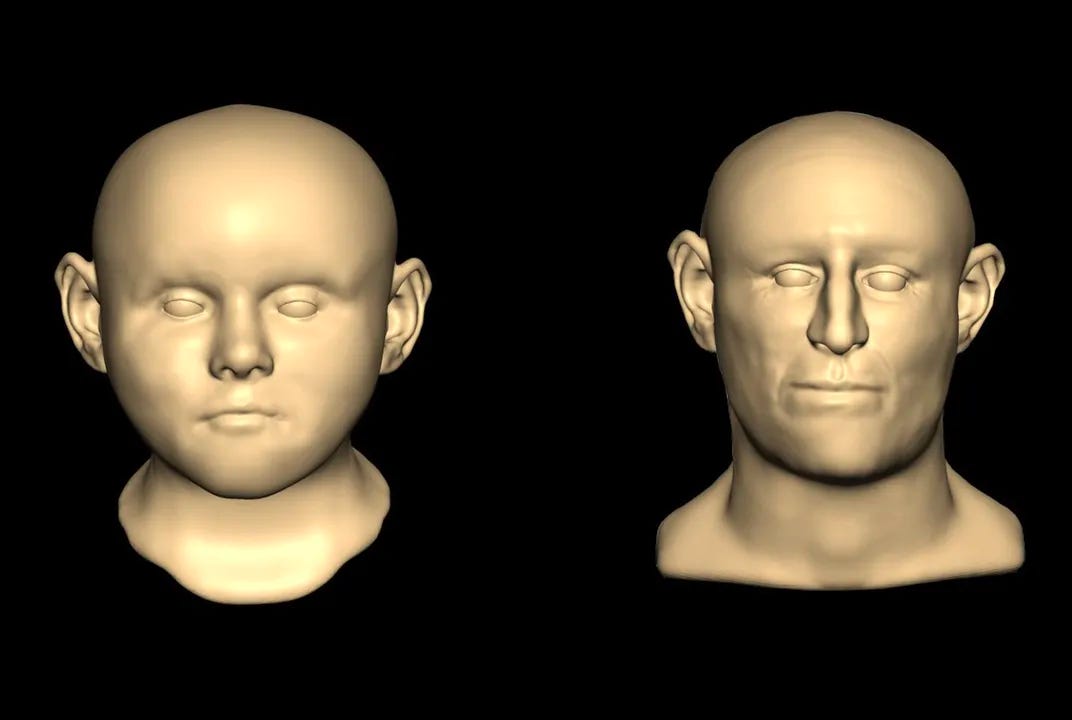
Here are the reconstructed images of two people found in the well, likely a father and son.
Why do I care?
Because my 23ndme DNA results reveal that I am related to three of the people found in that well.
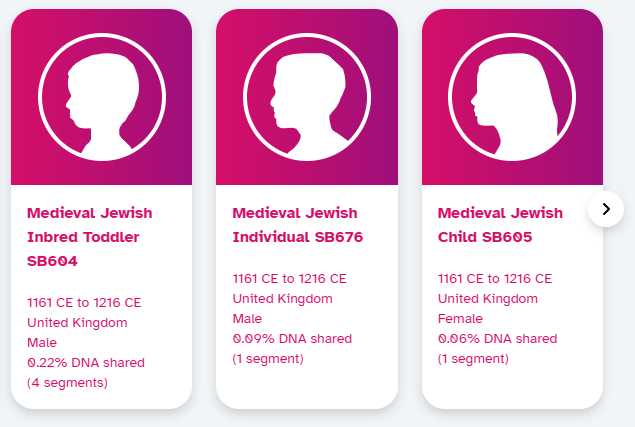
I share 0.22% of my DNA, from 4 segments, with a toddler found in that well. That means that toddler and I share a common ancestor.
So when I hear Donald Trump say immigrants “are poisoning the blood of the country”, it makes my blood boil. This is the same rhetoric that has sparked murder and genocide for centuries.
Whether it’s Jews or blacks or latinos, or native Americans or LGBTQ+ people or any other marginalized group, this kind of rhetoric leads to genocide and it must be condemned.
REMEMBER IN NOVEMER.


