

Short answer: yes—small amounts of alcohol over a long time can cause liver damage in some people, but the risk is much lower than with heavier drinking and varies a lot by individual factors.
Here’s the nuanced, evidence-based answer (and I’ll keep it clinically grounded, since you’re a physician):
✅ What counts as “small amounts”?
Roughly:
1 standard drink/day
(≈ 12 oz beer, 5 oz wine, or 1.5 oz spirits)Your example of ~4 oz wine is <1 standard drink
Traditionally this has been considered “low risk.”
⚠️ Can low-level drinking still cause liver damage?
✔️ Yes, but uncommon — and usually with cofactors
Most people drinking ≤1 drink/day do not develop clinically significant liver disease.
However, population studies and biopsy data show that some do.
Mechanisms:
Chronic oxidative stress
Acetaldehyde exposure
Gut permeability → endotoxin-mediated inflammation
Synergy with metabolic dysfunction
So even low-dose ethanol can contribute to:
Mild steatosis
Low-grade inflammation
Fibrosis progression if something else is already wrong
🔥 Biggest risk multiplier: Metabolic dysfunction (MASLD)
Alcohol + metabolic risk is not additive — it’s synergistic.
People with:
Insulin resistance
Central obesity
Dyslipidemia
Prediabetes / diabetes
have much higher fibrosis progression rates even with “light” drinking.
Several cohort studies show:
In patients with fatty liver, even <10 g ethanol/day is associated with
increased fibrosis progression and higher HCC risk compared to abstainers.
This is why guidelines are shifting away from “safe alcohol” in MASLD.
🧬 Other factors that make small amounts risky
Even modest intake can matter if there is:
Chronic viral hepatitis (HBV/HCV)
Hemochromatosis
Autoimmune liver disease
Medication hepatotoxicity (e.g., methotrexate, amiodarone)
Genetic susceptibility (PNPLA3, TM6SF2 variants)
In these groups, any alcohol is generally discouraged.
📊 What does epidemiology say about “safe” levels?
Older data suggested a J-shaped curve (cardio benefit, liver neutral).
Newer analyses correcting for abstainer bias show:
Lowest all-cause and liver risk is at zero or near-zero intake
Risk rises progressively from very low levels upward
So medically speaking:
There is no proven completely safe lifetime dose of alcohol for the liver,
only levels where risk is small for most people.
🧪 Practical clinical framing
In a metabolically healthy person:
Occasional or ≤1 drink/day → very low risk of liver damage
In MASLD / metabolic syndrome:
Even “small” daily drinking → measurable fibrosis risk over time
In known liver disease:
Recommendation = abstinence
🎯 Bottom line
✅ Yes, even small daily amounts can contribute to liver injury over decades, especially with metabolic risk or underlying liver disease.
❌ But for most healthy people, 4 oz wine/day alone is unlikely to cause clinically significant liver disease.
⚠️ The risk is not zero, and it’s highly individualized.
The strongest evidence that even small amounts of alcohol can cause liver damage comes from large population-based cohort studies demonstrating dose-dependent increases in liver disease risk at consumption levels below traditional “heavy drinking” thresholds.
A meta-analysis of over 2.6 million participants found that women consuming just one drink per day had an increased risk of liver cirrhosis compared to lifetime abstainers, while men did not show increased risk until higher consumption levels.[1] This sex difference reflects women’s greater vulnerability to alcohol-related liver injury at any given intake level.[2-3]
The FINRISK population cohort study of 8,345 individuals with fatty liver disease demonstrated that consuming 10-19 g/day of alcohol (less than one standard drink) doubled the risk of advanced liver disease compared to lifetime abstainers.[4] Even more striking, consuming 0-9 g/day as non-wine beverages also doubled this risk.[4] This study is particularly important because it controlled for multiple confounders and followed participants for up to 15 years.
A Korean cohort study of 190,048 adults found that while light alcohol consumption (1-9.9 g/day) appeared protective against simple steatosis, it increased the risk of developing fatty liver with fibrosis progression by 15%, with moderate consumption (10-29.9 g/day) increasing this risk by 49%.[5] This demonstrates that alcohol’s effects differ by disease stage, with even low levels promoting fibrosis.
The American Association for the Study of Liver Diseases identifies alcohol doses above one drink per day for women and two drinks per day for men as risk factors for alcohol-associated liver injury.[2] The American College of Gastroenterology notes that increasing evidence suggests any amount of alcohol use has potential to cause harm, though only 10-20% of heavy drinkers develop cirrhosis due to genetic and metabolic cofactors.[3]
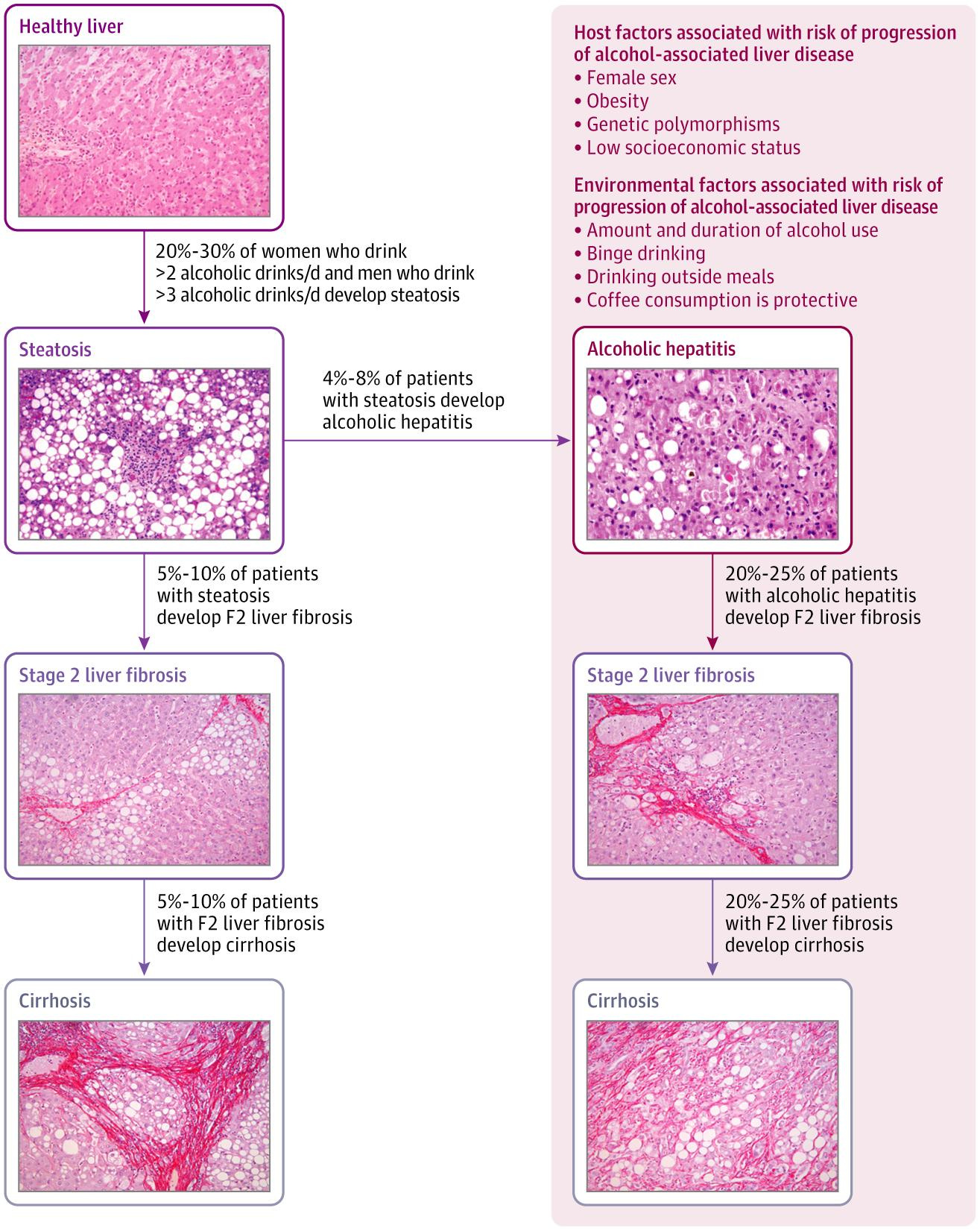
Figure 1. Histopathologic Features and Progression of Alcohol-Associated Liver Disease During 10 Years of Drinking More Than 2 Drinks per Day in Women and More Than 3 per Day in Men
Diagnosis and Treatment of Alcohol-Associated Liver Disease: A Review. JAMA. July 12, 2021.
Content used under license from the JAMA Network®
© American Medical Association
Current evidence indicates there is no liver-safe limit of alcohol intake in the presence of existing fatty liver disease or metabolic risk factors.[7] The dose-response relationship is exponential rather than linear, with women showing consistently higher risk than men at equivalent consumption levels.[1]
1.
Alcohol Consumption and Risk of Liver Cirrhosis: A Systematic Review and Meta-Analysis.
The American Journal of Gastroenterology. 2019. Roerecke M, Vafaei A, Hasan OSM, et al.
2.
Hepatology. 2019. Crabb DW, Im GY, Szabo G, Mellinger JL, Lucey MR.Guideline
3.
ACG Clinical Guideline: Alcohol-Associated Liver Disease.
The American Journal of Gastroenterology. 2023. Jophlin LL, Singal AK, Bataller R, et al.Guideline
4.
Risks of Light and Moderate Alcohol Use in Fatty Liver Disease: Follow-Up of Population Cohorts.
Hepatology. 2020. Åberg F, Puukka P, Salomaa V, et al.
5.
Hepatology. 2020. Chang Y, Ryu S, Kim Y, et al.
6.
Diagnosis and Treatment of Alcohol-Associated Liver Disease: A Review.

The Journal of the American Medical Association. 2021. Singal AK, Mathurin P.
7.
Synergistic and Detrimental Effects of Alcohol Intake on Progression of Liver Steatosis.
International Journal of Molecular Sciences. 2022. Di Ciaula A, Bonfrate L, Krawczyk M, Frühbeck G, Portincasa P.


